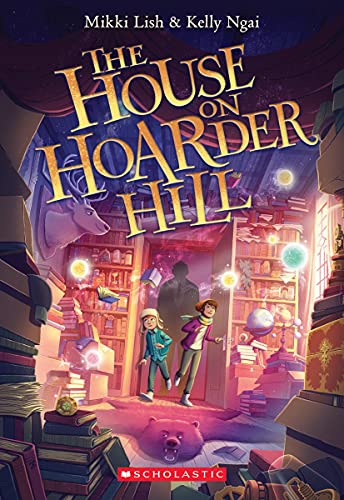
The House on Hoarder Hill

Juvenile Fantasy
Cover image for The House on Hoarder Hill series
Juvenile Fantasy

Summary

Nestled within the mist-shrouded hills of Eldoria, Hoarder Hill is a place where whispers echo through abandoned corridors and secrets cling to every shadow. Elara, a spirited youth, begins to unravel the strange phenomena surrounding her home, discovering that the boundary between the living and the spectral is thinner than anyone imagined. As she delves deeper into the eerie history of the town, she encounters spirits both helpful and malevolent, each with their own tales of sorrow and betrayal. Her journey becomes a tense dance of discovery and danger, forcing her to confront her fears and the truths about her own lineage. With each revelation, the stakes escalate, and Elara finds herself caught in a web of ancient curses and spectral vengeance that threaten to consume her and everyone she loves.

'The House on Hoarder Hill' marks Kelly Ngai's compelling shift into dark, atmospheric fantasy with a focus on psychological depth and intricate worldbuilding. While it may not have achieved widespread mainstream acclaim, it has been praised by critics for its inventive setting and strong character development, earning a dedicated following among fans of the genre. Some reviewers note that the series' dense, layered prose and complex plot require careful reading, which might challenge casual readers. However, its originality and bold storytelling place it as a notable work in Ngai's oeuvre, showcasing her mastery of blending horror-infused fantasy with nuanced emotional arcs.

Main Titles

On Hoarder Hill, a quiet, shadowed town clings to the strangest rumors: rooms that refuse to stay asleep, objects that remember their own kind of stories, and a family curse that bites at the edges...
On Hoarder Hill, a quiet, shadowed town clings to the strangest rumors: rooms that refuse to stay asleep, objects that remember their own kind of stories, and a family curse that bites at the edges of every doorstep. The protagonist, someone who has learned to keep their curiosity small and their questions closer, becomes entangled in a hidden library of memories tucked inside a crumbling house. Each creak and dust mote seems to whisper a clue, guiding them toward a map of the past that refuses to stay buried. The journey focuses on trust, on what a person is willing to rescue when the walls themselves seem to want to keep secrets. The house tests loyalty, reveals hidden grief, and asks what it means to belong when the world outside offers only silence and half-truths. As the layers peel back, the protagonist confronts a growing sense that the house is a living ledger of their family’s choices. Objects align like an uneasy chorus, hinting at a larger design that links the town’s fate to the house’s stubborn memory. The main character learns that courage isn’t the absence of fear but the choice to act despite it, especially when every doorway promises a new piece of the puzzle. Personal stakes sharpen as friendships are tested and the house’s demands grow more intimate, nudging the protagonist toward a decision that could rewrite their story forever. In the final stretch, the house itself becomes a character with a heartbeat of its own, pushing the protagonist toward a reckoning. The boundaries between memory and reality blur as truth arrives in the form of a whispered revelation and a choice only they can make. The ending threads a delicate balance between loss and hope, leaving a door softly ajar for what comes next and asking what a life saved by listening can truly mean.
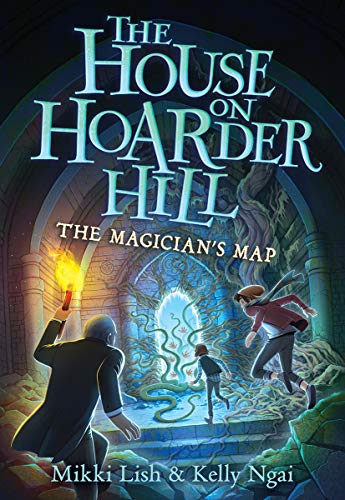
The Magician's Map follows the protagonist as they step into a world where every page turned unfurls a new bend in fate. The map at the story’s center is more than ink and lines; it is a living...
The Magician's Map follows the protagonist as they step into a world where every page turned unfurls a new bend in fate. The map at the story’s center is more than ink and lines; it is a living guide that reshapes itself with the holder’s choices, promising power yet delivering consequences that bind the traveler to a larger design. Our main character must learn to read not just the map’s routes but the moods of the places it reveals—cities that breathe, forests that speak in echoes, and a clockwork heart that beats out of sync with time itself. The journey becomes a test of patience, trust, and restraint, since the map favors those who listen first and rush later. As the path diverges, intimate alliances form with figures who understand the cost of magic and the price of certainty. The protagonist discovers that the map’s true edge lies not in distant horizons but in the choices made at each crossroads—the ones that reveal who they are when the world asks for a sacrifice. The stakes grow personal as a shadow from the past surfaces, threatening to derail the fragile progress built with new friends and hard-won wisdom. Yet courage and curiosity fuse, guiding the traveler toward a decision that will either seal their future or unlock a hidden doorway to possibilities they never imagined. In the narrative’s quiet, purposeful cadence, the protagonist learns that mastery is never merely a destination but a discipline of listening, choosing, and letting the map teach patience. The ending threads a vow to keep searching while guarding what matters most, hinting at a broader purpose that promises more revelations to come and a continuity that invites readers to walk the next path with them.